

Even the most enduring games eventually reach their breaking point, no matter how stable the engine or simple the graphics. While it’s easy enough to crash a modern indie title like 20 Minutes Till Dawn after extended play, the question of how long a classic like Doom can run before succumbing to system limits has finally been answered. A member of the Len0w0 forum, known as “Minki,” has proven through careful calculation and persistence that the 1993 shooter can run continuously for years before reaching an overflow state that forces it to crash.
The experiment started with theoretical math. According to Minki, the Windows 3.1 version of Doom should take roughly 2.5 years to hit a point where the game’s engine overflows, producing an inevitable crash. Rather than leave it as speculation, they decided to put the prediction to the test. To do so, they chose an unlikely machine: an early 2000s Asus MyPal Windows Mobile Pocket PC, closely resembling the 2003 A620 model. The handheld was hooked up to a steady 5-volt power source and backed by an uninterruptible power supply to ensure uninterrupted operation.
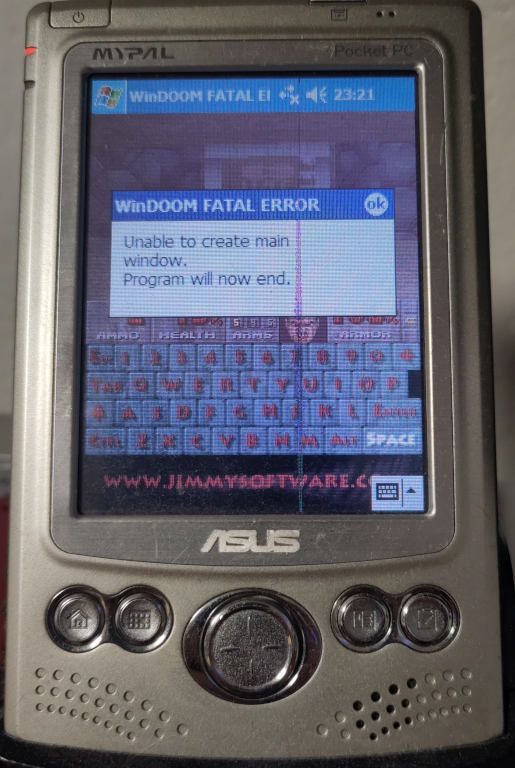
After more than two years of constant play, the prediction came true. The game finally failed with the exact overflow error Minki had calculated, and remarkably, the crash occurred just hours after the projected timeframe. The successful outcome highlights not only the durability of id Software’s legendary shooter but also the precision of the technical forecast that guided the experiment.
It’s a quirky but fascinating demonstration of how even decades-old software can provide insight into computer science fundamentals. Beyond celebrating Doom’s reputation as the game that runs on everything, Minki’s experiment also shows the lengths to which dedicated fans will go to test the resilience of iconic programs. For a piece of 1990s gaming history to hold up under such scrutiny—and quite literally run for years without faltering—is an achievement in itself.