
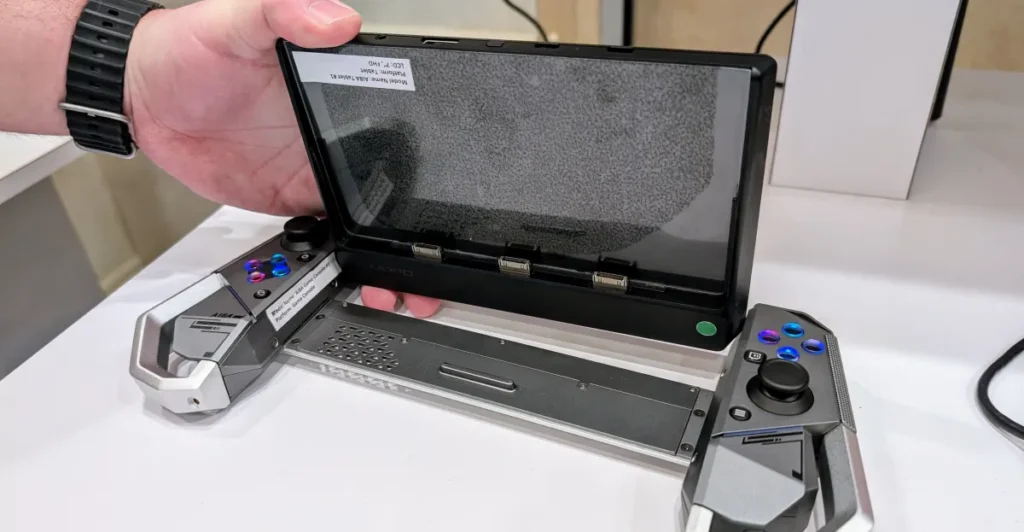
Intel officially lifted the curtain on its Core Ultra Series 3 “Panther Lake” mobile processors at CES 2026, positioning the chips as a major step forward in efficiency and integrated graphics performance. Built around Intel’s new Arc Xe3 GPU architecture, Panther Lake promises a rare combination of long battery life and surprisingly capable graphics—an approach that could finally give Intel real momentum in the fast-growing PC gaming handheld market, a segment largely dominated by AMD’s Ryzen Z-series chips.
Intel is clearly aiming directly at that space. During CES, Nish Neelalojanan, Intel’s senior director of client product management, argued that Panther Lake represents a more modern solution than AMD’s current handheld offerings, suggesting that AMD’s lower-tier Ryzen Z2 chips rely on older CPU and GPU technology to hit cost targets. The implication was clear: Intel believes Panther Lake’s newer architecture and graphics capabilities could offer handheld makers a more future-proof platform.
AMD, however, is pushing back hard. In a roundtable interview at CES, Rahul Tikoo, senior vice president and general manager of AMD’s client business, rejected the idea that Intel’s notebook-first approach is the right fit for handheld gaming devices. Tikoo emphasized AMD’s experience designing semi-custom silicon for consoles, arguing that handhelds demand purpose-built chips that prioritize graphics performance, efficiency, and software integration over general-purpose compute and I/O. According to AMD, notebook-class designs like Panther Lake carry unnecessary overhead—what Tikoo described as “baggage”—that isn’t ideal for tightly constrained handheld form factors.
The debate also extended to battery life, where Intel has leaned heavily on its low-power E-cores as a key advantage. AMD countered by questioning Intel’s real-world efficiency claims, pointing to scenarios where performance drops sharply when Intel systems are tested on battery power rather than while plugged in. AMD maintains that its own designs strike a better balance between efficiency and sustained performance, removing complexity for device makers and end users alike.
Despite the back-and-forth, early hands-on testing at CES suggests the battle may be closer than AMD implies. Limited benchmarks showed Panther Lake delivering relatively consistent frame rates whether plugged in or running on battery, hinting that Intel may have addressed some of the power-performance trade-offs that plagued earlier designs. With both companies now openly trading blows, the PC gaming handheld market is shaping up to be one of the most hotly contested battlegrounds in mobile silicon over the next year.