

Chip technology firm Arm Holdings has reorganized its operations to create a new “Physical AI” business unit, aiming to deepen its presence in the fast-growing robotics market, company executives told Reuters at the Consumer Electronics Show (CES) in Las Vegas.
The move comes as robotics — particularly humanoid robots — emerges as a dominant theme at CES, with companies showcasing machines designed to perform tasks ranging from manufacturing and cleaning to logistics and gaming. Arm’s decision reflects a broader industry push by technology firms and automakers to translate advances in artificial intelligence into physical systems.
Under the reorganization, Arm will now operate three main business lines: Cloud and AI, Edge — which includes mobile and PC technologies — and Physical AI. The new unit will house Arm’s automotive business alongside robotics, reflecting overlapping requirements in sensors, power efficiency, safety, and reliability.
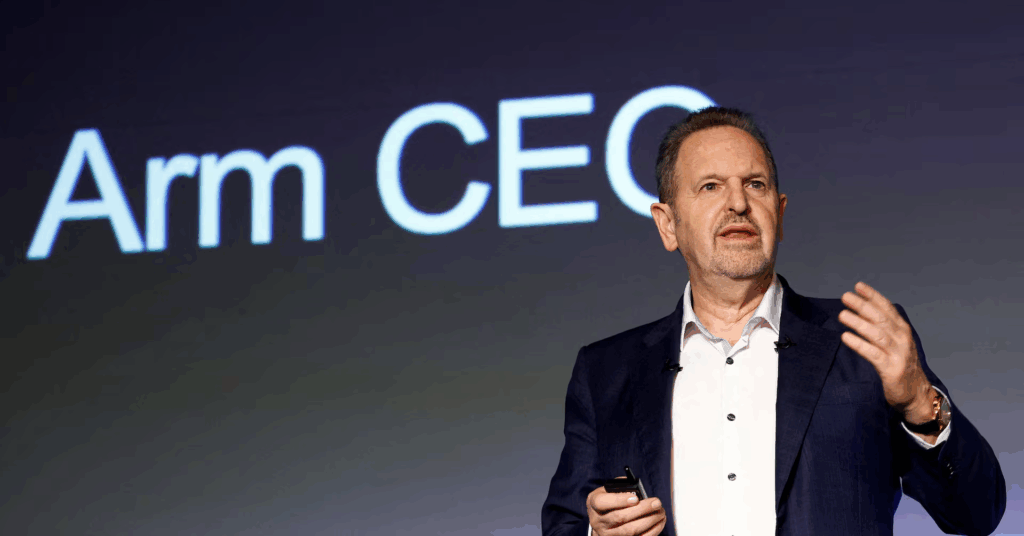
Arm does not manufacture chips itself but licenses its designs, which power most of the world’s smartphones and are increasingly used in laptops, data centers, vehicles, and robots. The company earns revenue through licensing fees and royalties. Since Chief Executive Rene Haas took over about four years ago, Arm has pursued higher pricing for advanced designs and explored the possibility of developing full chip designs of its own.
Drew Henry, head of the newly formed Physical AI unit, said robotics represents a long-term growth opportunity, with the potential to “fundamentally enhance labor” and free up human time, which could ultimately boost economic productivity. Arm plans to add dedicated robotics staff within the new division, according to Chief Marketing Officer Ami Badani.
Arm said it combined automotive and robotics into one unit because customer needs in both areas are closely aligned. Arm-based chips are already used by dozens of automakers and by robotics firms such as Boston Dynamics, which is owned by Hyundai Motor Group. The two companies recently unveiled a production-ready Atlas humanoid robot that Hyundai plans to deploy in U.S. factories by 2028.
ROBOTICS SURGE AT CES
Interest in humanoid robots has accelerated as companies across technology and automotive sectors view them as the next frontier in AI-driven automation. Tesla Chief Executive Elon Musk has described Tesla’s Optimus humanoid robot as central to the company’s future, suggesting it could eventually surpass the value of its vehicle business.
CES this year featured dozens of humanoid robots performing demonstrations such as dancing, playing table tennis, and carrying out repetitive industrial tasks. Many of these machines incorporate AI systems to improve precision, adaptability, and productivity.
C.J. Finn, U.S. automotive industry leader at PwC, said the biggest investments are flowing into systems that tightly integrate advanced AI with mechanical design. Meanwhile, Mobileye, partly owned by Intel, announced plans to acquire robotics firm Mentee for $900 million.
AI chip leader Nvidia also unveiled new physical AI tools, including a platform called Alpamayo, aimed at supporting the next generation of autonomous vehicles and robots.
Arm executives said the creation of the Physical AI unit positions the company to play a central role as AI increasingly moves from the digital world into physical machines.