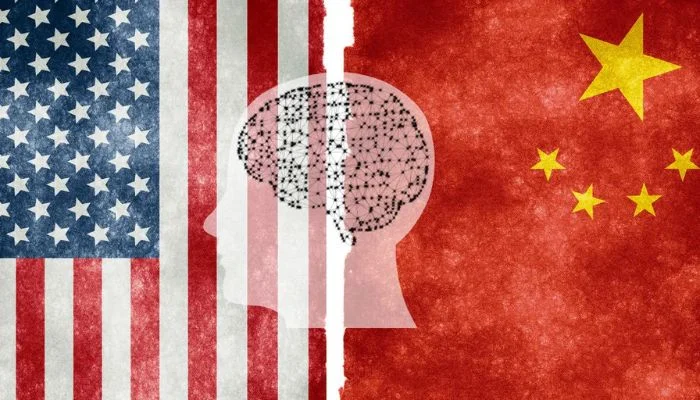
China has sharply criticized the United States over potential investigations and sanctions targeting Chinese artificial intelligence companies, accusing Washington of pursuing “AI hegemonism” amid an escalating dispute over AI model development and intellectual property.
The response from China’s Ministry of Commerce follows statements from senior U.S. officials indicating that Chinese AI developers could face trade restrictions, financial sanctions, or export controls if investigations determine they unlawfully copied advanced American AI technologies.
At the center of the dispute is Moonshot AI, the Beijing-based developer of the Kimi K3 large language model. U.S. officials have alleged that the company may have relied on large-scale model distillation techniques involving American frontier AI systems during development.
Model distillation is a widely used machine learning method in which a smaller or newer model learns from the outputs of a more advanced model. While the technique is widely accepted within the AI industry under appropriate licensing conditions, U.S. policymakers argue that unauthorized large-scale extraction of proprietary model behavior could constitute intellectual property infringement.
China rejected those allegations, stating that the United States has provided neither sufficient factual evidence nor legal justification for threatening punitive measures against Chinese technology companies. The Ministry of Commerce warned that Beijing would take “all necessary measures” to protect the legitimate interests of Chinese businesses if U.S. actions result in material harm.
The controversy reflects the growing strategic competition between the world’s two largest economies over artificial intelligence leadership. As Chinese AI companies rapidly improve the performance of their frontier models, questions surrounding innovation, technology transfer, and intellectual property protection have become increasingly prominent in Washington.
According to recent statements from U.S. officials, intelligence assessments suggest Moonshot AI may have used sophisticated infrastructure to access American AI systems while allegedly employing multiple techniques to avoid detection. Officials have also expressed concerns regarding the company’s reported access to advanced AI computing hardware.
Moonshot AI has firmly denied the accusations, stating that the performance improvements demonstrated by Kimi K3 are the result of original architectural innovations and internal research rather than unauthorized model distillation.
The dispute has also renewed attention on the U.S. Entity List, a trade restriction mechanism that can significantly limit foreign companies’ access to American semiconductors, software, cloud computing services, and other critical technologies. Similar measures have previously been applied to several major Chinese technology firms.
Beyond the immediate allegations, the case highlights a broader policy debate surrounding open-weight AI models and the balance between encouraging innovation and protecting intellectual property. As frontier AI models become more capable and widely available, governments are increasingly examining how existing copyright, licensing, and export control frameworks should apply to advanced machine learning systems.
The outcome of the dispute could have significant implications for global AI development, semiconductor supply chains, and future cooperation between international technology companies as geopolitical competition continues to reshape the artificial intelligence landscape.