
In an era where data security has never been more critical, simply deleting files is no longer enough to guarantee that sensitive information is truly gone. Even basic data recovery tools can often retrieve deleted files, while more advanced forensic analysis can uncover data thought to be lost forever. Recognizing this challenge, TeamGroup has unveiled an innovative solution for those who require absolute certainty: a “self-destructing” solid-state drive designed to irreversibly destroy its stored data on demand.
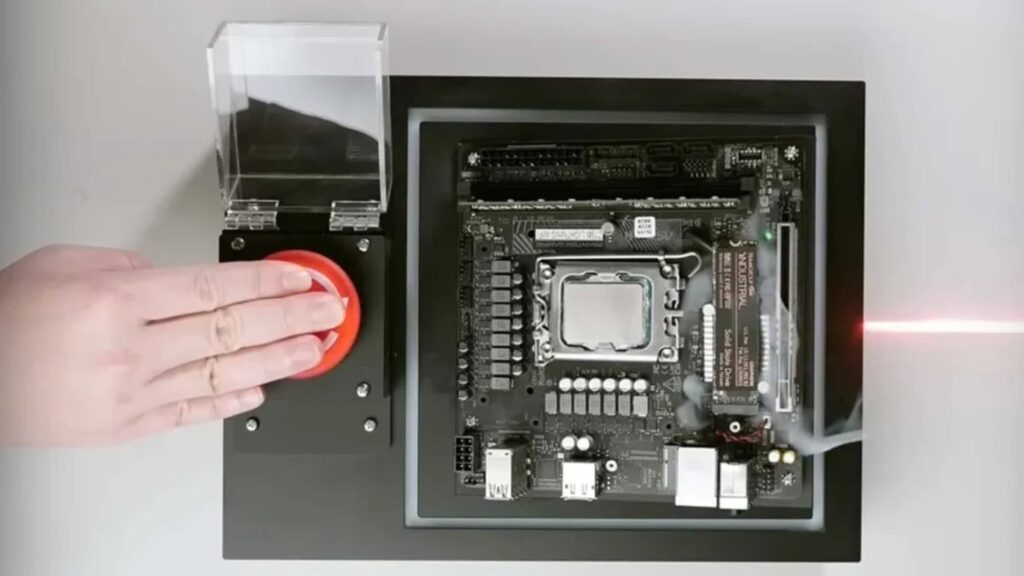
The P250Q-M80 SSD, recently highlighted by VideoCardz, introduces a one-of-a-kind feature—a dedicated destruction circuit that physically obliterates the drive’s flash memory chips with the press of a button. Unlike software-based secure erase methods, this hardware-level mechanism ensures that the NAND memory is rendered completely unusable. Even more impressively, the drive supports connecting an external, physical button that can be mounted anywhere, allowing users to initiate the destruction process manually without accessing the computer itself.
TeamGroup demonstrated this feature in a dramatic official video shared via Computex’s YouTube channel. Holding the external button for 10 seconds triggers the destruction, visibly damaging the memory chips and even producing smoke—whether real or theatrical, it certainly drives home the point. The drive includes LED indicators that display the destruction’s progress, and the process is designed to continue even in the event of a sudden power loss, ensuring the data is thoroughly destroyed.
Beyond this extreme functionality, the P250Q-M80 also offers more conventional security features typical of a Gen 4 SSD, including software-based permanent data erasure options that do not disable the drive. TeamGroup envisions its self-destructing SSD being particularly useful for defense, automation, or industrial applications where data security is paramount and rapid physical destruction is necessary. Of course, there’s no shortage of speculative interest from individuals seeking more “creative” approaches to data privacy.
Performance-wise, the drive offers respectable speeds—up to 7,000 MB/s read and 5,500 MB/s write—and comes in capacities up to 2TB. While these specs don’t top the charts, the device’s primary value lies in its specialized security capability rather than raw speed or storage size. Pricing details remain undisclosed, reflecting the niche market this product targets, but interested parties can inquire directly through TeamGroup’s official channels.