
Microsoft’s long history of nudging users away from competitors is extending deep into the AI space. If you’ve ever searched for “Google” on Bing.com, you’ve probably seen reminders that Microsoft already offers its own search engine. Now, those tactics are showing up when people look for other AI tools, encouraging them to stay within the Microsoft ecosystem and use Copilot instead.
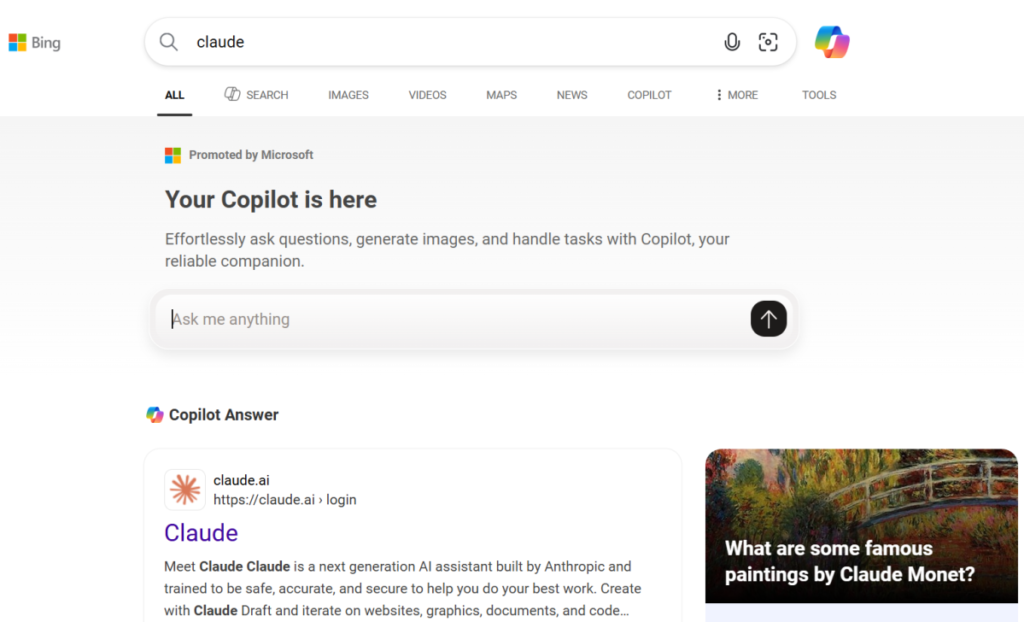
For example, searching for “Claude” — Anthropic’s AI chatbot — in Microsoft Edge with Bing set as the default search engine will still display the correct link and related details. But it also places a prominent banner reading “Your Copilot is here”, complete with a Copilot-specific search box. According to reporting from Windows Latest, these prompts are injected by Bing.com itself rather than Edge, meaning they can appear regardless of whether you’ve actually interacted with Copilot before.
While the strategy may seem aggressive, Microsoft’s approach appears to be yielding results. In its most recent fiscal fourth quarter, the company reported a 21 percent year-over-year increase in search and news advertising revenue (excluding traffic acquisition costs). Although the company didn’t break down which platforms or services drove that growth, it’s safe to assume Bing search ads, Copilot promotions, and integrated Windows widgets all contributed.
And while OpenAI’s ChatGPT still dominates AI chatbot traffic, Copilot made an unexpected leap into second place around May. That surge could be partially explained by tracking irregularities, but it’s also possible that Microsoft’s tight integration of Copilot into Windows, Office, and Bing — combined with retention tactics like these — has helped. The real question is whether these strategies are convincing users to genuinely prefer Copilot, or simply keeping them in Microsoft’s ecosystem by making it more difficult to leave.