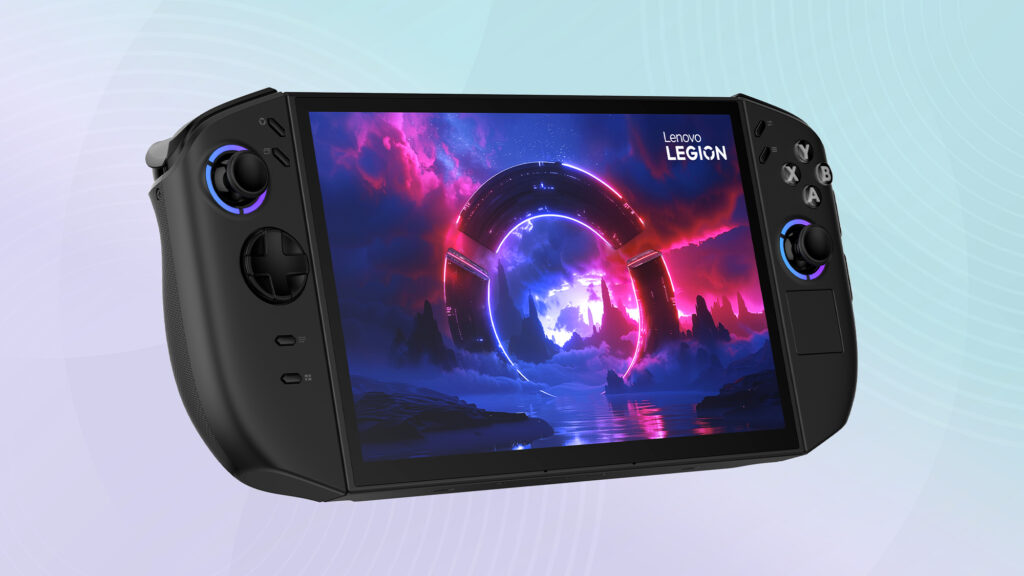
Lenovo is doubling down on handheld PC gaming with the official reveal of its second-generation portable, the Legion Go 2, set to launch in October. Building on the bold but niche design of the original Legion Go, the new model refines the hardware and leans heavily into Windows as its primary platform. Powered by AMD’s cutting-edge Ryzen Z2 Extreme APU, complete with eight Zen 5 CPU cores and a 16-core RDNA 3.5 GPU, the Legion Go 2 positions itself as one of the most powerful Windows-based handhelds on the market — though the starting price of $1,049 makes clear that Lenovo is chasing enthusiasts rather than budget-conscious gamers.
The Legion Go 2 keeps the signature 8.8-inch display, but this time Lenovo is opting for an OLED upgrade while keeping the resolution at a practical 1920×1200. That’s paired with a 144Hz refresh rate and VRR support down to 30Hz, giving players some breathing room for demanding AAA titles. The detachable controllers, complete with hall-effect joysticks and a right-hand module that can double as a pseudo gaming mouse, also return with tweaks for improved ergonomics and compatibility with the first-generation device. Add in extras like a kickstand, dual USB-C ports, and an oversized touchpad, and Lenovo is clearly committed to offering a hybrid between portable gaming console and ultra-compact PC.
Specs can scale impressively high, with up to 32GB of DDR5 RAM at 8000MHz, 2TB of Gen4 SSD storage, and an expanded 74Wh battery that’s more than 50% larger than the first Legion Go’s pack. A MicroSD slot with support for up to another 2TB adds further flexibility. However, Lenovo notes that these “up to” specs won’t be standard, meaning the $1,049 base model will ship with lower configurations. That said, the larger battery and upgraded controllers appear to be standard across the range, giving every SKU a meaningful upgrade.
While Lenovo is sticking with the clunky “Legion Go (8.8”, 2)” name for retail listings, enthusiasts will simply see this as the Legion Go 2 — a device clearly built to compete with rivals like Asus’ upcoming ROG Ally X, which will also hit the market this October. Asus has the edge with its early access to Microsoft’s game-focused Windows 11 handheld interface, but that advantage may not last beyond 2026. With tariffs and import costs creating price uncertainty, Lenovo’s premium pricing could shift before launch. Still, the Legion Go 2 cements itself as one of the most ambitious handheld gaming PCs yet, blending raw performance, Windows flexibility, and Switch-inspired modular hardware into a device aimed squarely at hardcore gamers.