
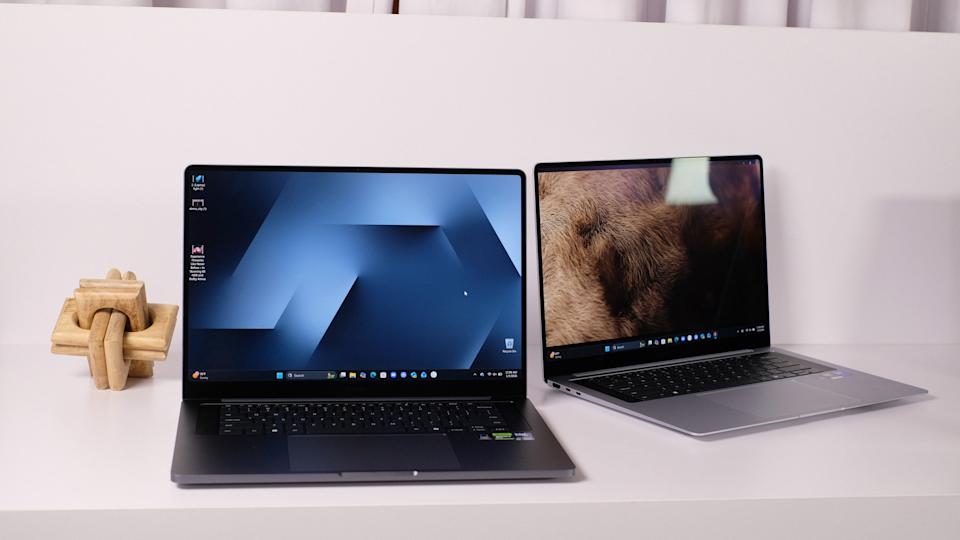
Samsung has unveiled its Galaxy Book 6 lineup at CES 2026, timing the launch closely with Intel’s debut of its Core Ultra Series 3 processors, also known as Panther Lake. The company is positioning the new notebooks around efficiency and endurance, highlighting claims of up to 40 hours of battery life alongside what it describes as a “tuned” implementation of Intel’s latest architecture.
The Galaxy Book 6 family consists of three models: the standard Galaxy Book 6, the Galaxy Book 6 Pro, and the flagship Galaxy Book 6 Ultra. The base model targets everyday productivity users with relatively modest specifications, offering 14-inch and 16-inch displays at 1200p resolution. At the top end, the Galaxy Book 6 Ultra is clearly aimed at creators and power users, pairing a 16-inch AMOLED panel with resolutions up to 2880×1800 and optional Nvidia RTX 5060 or RTX 5070 discrete graphics.
Samsung says it has significantly reworked the thermal design inside the Pro and Ultra models to support the performance uplift enabled by Panther Lake. The updated cooling solution features expanded heatsink fins arranged at optimized angles, alongside a new “dual-path” cooling approach that is designed to draw heat away from more internal components than before. According to Samsung, this redesigned, Samsung-tuned system delivers up to 1.6× higher CPU performance and 1.7× higher GPU performance compared to the previous generation.
Multimedia is another area Samsung is emphasizing this year. The Galaxy Book 6 lineup introduces a redesigned six-speaker audio system, replacing the previous four-speaker configuration with four woofers and two tweeters. This change is intended to improve bass response and overall sound clarity, reinforcing the Galaxy Book’s reputation as a strong option for media consumption now that OLED displays have become more common across competing laptops.
Samsung’s AMOLED 2X displays also see incremental but meaningful improvements. Most notably, the panels now support a dynamic refresh rate that can drop as low as 30Hz, instead of the previous 60Hz floor. This lower refresh rate is designed for static workloads such as document editing and reading, where smoother motion is unnecessary, helping reduce power consumption and extend battery life.
That efficiency focus ties directly into Samsung’s headline battery claims. The company says the Galaxy Book 6 can reach up to 40 hours of battery life during video playback, and fast charging allows the notebook to recover up to 63 percent of its battery in just 30 minutes. While video playback is an optimistic metric, the combination of Panther Lake efficiency and lower idle refresh rates suggests meaningful real-world gains.
Other refinements include a haptic touchpad that is now standard across the lineup, though Samsung notes it does not support stylus inking. Storage and memory options are expansive at the high end, with the Galaxy Book 6 Ultra configurable with up to 2TB of storage and as much as 64GB of RAM. Samsung has not yet announced pricing or availability, citing ongoing uncertainty around memory costs, but more details are expected later.