

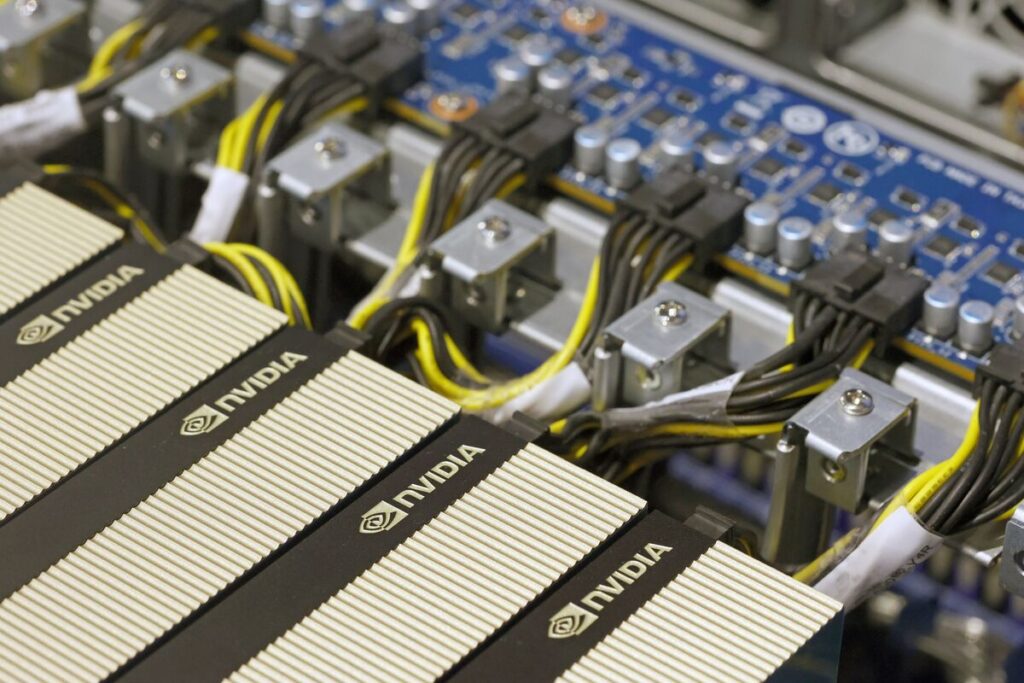
After months of speculation, the Trump administration has formally imposed tariffs on a narrow category of semiconductors, marking a significant development in U.S. trade and technology policy. The measure applies to certain advanced AI chips, including Nvidia’s H200 accelerators and comparable products such as AMD’s MI325X, when those chips are manufactured outside the United States, transit through U.S. territory, and are then exported onward to customers in other countries, including China.
President Donald Trump signed the proclamation on Wednesday, establishing a 25% tariff on these advanced AI semiconductors. The order targets a specific logistics pathway rather than blanket semiconductor imports, reflecting a more tailored approach to balancing national security concerns with the commercial interests of U.S. chipmakers. Chips imported into the U.S. for domestic use — including research, defense, or commercial deployment — are explicitly excluded from the tariff.
The announcement formalizes an important element of the U.S. Department of Commerce’s recent decision to permit Nvidia to resume shipments of its H200 AI chips to vetted customers in China, a policy shift that took effect in December. Under the arrangement, sales are limited to approved commercial buyers and subject to government oversight. Despite the added tariff burden, Nvidia welcomed the move, emphasizing the opportunity to compete internationally while supporting U.S. jobs and manufacturing.
“We applaud President Trump’s decision to allow America’s chip industry to compete to support high-paying jobs and manufacturing in America,” an Nvidia spokesperson said. “Offering H200 to approved commercial customers, vetted by the Department of Commerce, strikes a thoughtful balance that is great for America.”
The commercial stakes are substantial. Nvidia’s H200 chips remain in high demand among Chinese technology companies, particularly those racing to build or expand large-scale AI infrastructure. Reports indicate Nvidia had been considering increasing production of the H200 in response to a surge of early orders from China, underscoring the continued appetite for cutting-edge U.S. AI hardware despite tightening geopolitical controls.
However, demand alone will not determine how the market evolves. China’s own regulatory posture is a critical variable. Beijing faces a strategic dilemma similar to Washington’s, though from the opposite position: it aims to accelerate the development of a self-sufficient domestic semiconductor industry while avoiding a near-term slowdown in AI progress that could result from cutting off access to foreign chips.
According to reporting from Nikkei Asia, China’s central government is drafting new rules that would define how many overseas semiconductors domestic companies are permitted to purchase. Such guidelines could open the door to continued, albeit regulated, imports of Nvidia’s AI chips, representing a potential softening of China’s previously hardline stance on foreign semiconductor dependence.
The U.S. proclamation places the tariff decision within a broader national security and economic framework. It notes that the United States currently manufactures only about 10% of the chips it consumes, leaving critical industries dependent on foreign supply chains. That reliance, the document argues, poses significant economic and security risks, particularly as semiconductors become increasingly central to military systems, advanced manufacturing, and artificial intelligence.
By carving out limited tariffs while still allowing controlled exports, the administration appears to be pursuing a dual-track strategy: pressuring companies to invest more heavily in domestic manufacturing, while avoiding a complete severing of commercial ties that could disadvantage U.S. firms in the global AI race. How effective that balance proves will depend not only on U.S. enforcement, but also on how China chooses to regulate access to foreign AI hardware in the months ahead.